|
About the SMP
 Our
shoreline is constantly changing, sometimes gradually, sometimes
dramatically, and these changes have created some of the coast's most
beautiful and important features. They also, however, represent a
threat to many of our coastal communities. To protect these
communities we have often had to resort to building coastal defences. Our
shoreline is constantly changing, sometimes gradually, sometimes
dramatically, and these changes have created some of the coast's most
beautiful and important features. They also, however, represent a
threat to many of our coastal communities. To protect these
communities we have often had to resort to building coastal defences.
Until relatively recently, defences were
constructed on an ad-hoc basis over relatively short lengths of coastline
the boundaries of which were usually marked by administrative borders
- an approach which failed to consider the impact on other coastlines and
often resulted in erosion and flood problems downdrift.
In 1994 the Coastal Groups and local authorities
of England & Wales were encouraged by Government to adopt the concept of
Shoreline Management Plans (SMPs), with a view to providing a more
strategic and sustainable approach to coastal defence.
 The SMP
sets
out the
policy for managing our coastline
and how we respond to the threat
of coastal
flooding and
the risks of
erosion. It
is a high level non-statutory policy document that
aims to
balance those risks with natural
processes and the consequences of climate change. It needs to take
account of existing defences and the natural and built environments, and
be compatible with adjacent coastal areas. The SMP
sets
out the
policy for managing our coastline
and how we respond to the threat
of coastal
flooding and
the risks of
erosion. It
is a high level non-statutory policy document that
aims to
balance those risks with natural
processes and the consequences of climate change. It needs to take
account of existing defences and the natural and built environments, and
be compatible with adjacent coastal areas.
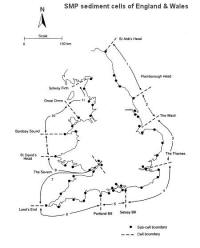
SMPs
divide the shoreline of England & Wales into a series of cells and
subcells (map right, click to enlarge it), defined by coastal type
and processes such as the movement of beach and seabed sediment within
and between them.
The
shoreline covered by the local SMP stretches from Durlston Bay to Hurst Spit, known
nationally as
Subcell 5F.
The local SMP
The first local SMP (SMP1)
was produced
by the Poole &
Christchurch Bays Coastal Group
in 1999. SMP2, published late October
2010, is the first review of that document.
SMP2 promotes
management policies for a coastline into the 22nd Century that achieve
long-term objectives without committing to unsustainable defence. It is
recognised, however, that due to present day objectives and acceptance,
wholesale changes to existing management practices may not be appropriate
in the very short term.
Consequently, the SMP
provides a timeline for objectives, policy and management changes; i.e. a
‘route map’ for decision makers to move from the present situation towards
the future.
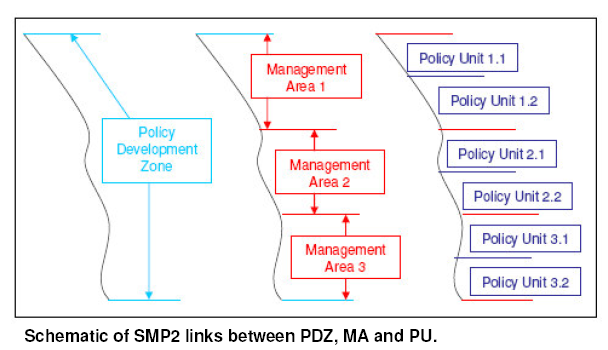
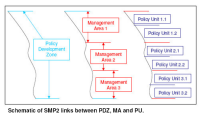 SMP2
divides Subcell 5F into four 'Policy Development Zones' (PDZs); each PDZ
is divided into a number of 'Management Areas' (MAs) and MAs into 'Policy
Units' (PUs). SMP2
divides Subcell 5F into four 'Policy Development Zones' (PDZs); each PDZ
is divided into a number of 'Management Areas' (MAs) and MAs into 'Policy
Units' (PUs).
For instance Durlston
Bay & Swanage Bay is PDZ4, divided into Management Areas DUR.O and SWA.N;
then sub-divided into Policy Unit O.1 at Durlston Bay and Policy Units
N.1-N.4 at Swanage Bay (see the
Policy
Summary Map for further detail).
The Plan identifies one of four
shoreline management policies for each Policy Unit:
|
Shoreline Management Policy options: |
|
 |
Hold the Line
-
defences are maintained and upgraded or replaced in their current
position where funding permits. |
|
|
Managed
Realignment
-
this policy allows realignment of the shoreline (forwards or
backwards) with management to control or limit the movement.
Any increase in flood risk will also be managed. Although this
policy typically applies to low-lying areas at risk of flooding it
can equally apply to cliffed areas, whereby cliff recession could be
slowed down for a period of time. |
|
|
No Active Intervention
(do nothing) - this is a policy decision not to invest in the
provision or maintenance of any defences. Where there are no
existing defences the shoreline will continue to evolve naturally.
This policy can also apply to areas that are currently defended but
may not be defended in the future. These areas will evolve
more naturally, which may include an increased risk of flooding or
coastal erosion. It may be necessary to intervene (by removing
old defences) in order that a 'No Active Intervention' policy can be
implemented |
|
|
Advance the Line
- new defences are built seaward of existing defences where funding
permits, involving a significant reclamation of land in the process. |
|
The 22 SMPs produced for the shoreline of England & Wales form an
important element of Defra & NAW's Strategy for Flood and Coastal
Defence.
Defra
- Department of Environment, Food and Rural Affairs
NAW -
National Assembly for Wales
|